
June 17, 2026, 7:00 PM
Pawilon, 3 Ewangelicka Street
film, meeting, free admission
Age: 16+, themes of depression, discrimination (in the content or as a critical theme)
The guest of the June edition of States of Matter will be visual artist Liliana Zeic. After the screening of the film “Metamorphosis” (dir. Institute of Queer Ecology), there will be a conversation with the invited artist, during which we will try to define the meaning of queer ecology for contemporary art. An additional point of reference will be the collective publication about Liliana Zeic’s art titled “Pokrzywnice, dziwaczki, straszydła. Sztuka Liliany Zeic” (ed. Piotr Lisowski, publ. 66P, 2025).
Queer ecology differs from the traditional one in that, drawing on an intersectional approach, it establishes an interspecies community of humans and non-humans. The environment is perceived in it as a network of interdependencies, in which cooperation appears as a condition for the continued functioning of nature. The postulated future here is free from heteronormative and patriarchal perception and ways of valuation.
“Metamorphosis” (2020, Institute of Queer Ecology, 47 min)
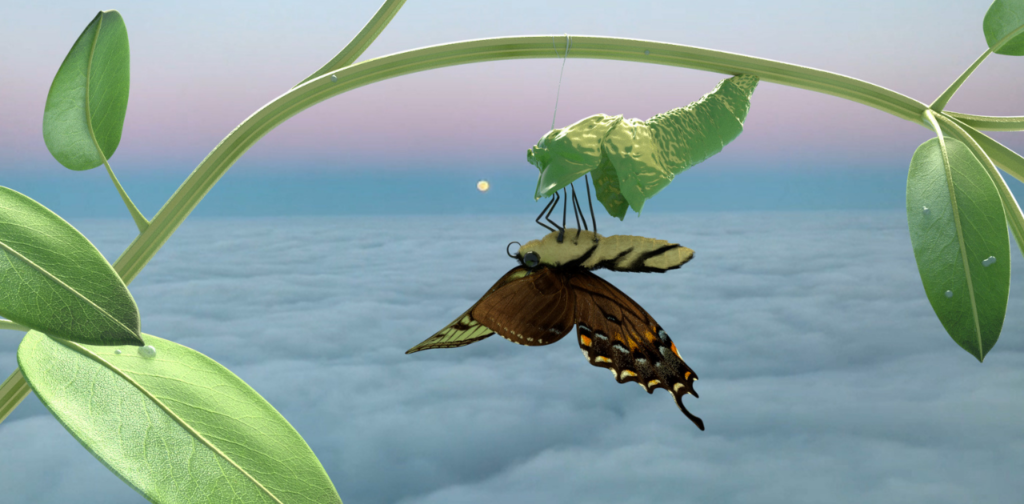
“Metamorphosis” is a video manifesto consisting of three parts, and each of them corresponds to one of the stages of the developmental cycle of holometabolous insects – creatures undergoing complete metamorphosis, consisting in a total transformation of the organism, adapting to changing conditions and needs.
The Institute of Queer Ecology uses this metaphor, trying to change the human way of thinking about reality, and therefore proposes that we move from attempts to subordinate nature to ourselves (extractivism) to cooperation with it (regeneration, care).
The larval stage (part 1) corresponds to the capitalist desire for consumption and unlimited accumulation of goods – humans resemble caterpillars here, which increase their weight tenfold in less than three weeks.
The pupa (part 2) is a state in which the caterpillar releases enzymes dissolving most of its tissues so that it can be rebuilt – liquefaction and fluidity carry economic associations and refer here to the conversion of material goods into cash in times of crisis.
Finally, the last developmental stage (part 3) focuses on the figure of an androgynous butterfly, which becomes a metaphor for a warm, blurred, queer future – the film poetically speculates on the possibility of achieving it.
Liliana Zeic (formerly Liliana Piskorska, born 1988, she/her) – visual artist, Doctor of Fine Arts. Graduate of the Faculty of Fine Arts at Nicolaus Copernicus University in Toruń, in 2011 a student at the University of Warsaw. In 2017, she defended her doctoral dissertation at the Faculty of Fine Arts in Toruń (supervisor: Elżbieta Jabłońska).
Finalist of the Forecast Forum at Haus der Kulturen der Welt in Berlin in 2017. Winner of the audience award Spojrzenia 2019: Deutsche Bank Award. Winner of OP YOUNG 2020, in the same year nominated for the WARTO award.
Her works have been shown at over 140 group and individual exhibitions in Poland and abroad and are held in public collections, including Zachęta – National Gallery of Art, the Museum of Contemporary Art Wrocław, Galeria Miejska Arsenał, NOMUS and the Museum of Art in Łódź. Represented by lokal_30 gallery. She lives in Warsaw.
STATES OF MATTER – a cycle of post-film events curated by Andrzej Marzec. Each meeting consists of a short lecture, a film screening and a conversation with invited artists. This year, each event also has a specific leading theme, thematized in the film and addressed in the discussion. An additional point of reference for the conversation is each time a book selected or published by the guest and/or female guest of the cycle.
States of Matter focuses on the work of stitching, integrating and saving a reality cut through and torn apart by various coexisting crises. The answer to the experience of a collapsing, fragmented world is no longer great, escapist, utopian projects, but rather everyday, local, perhaps even provisional practices of small repairs and attempts at regeneration.